The Upcoming Ethereum Merge

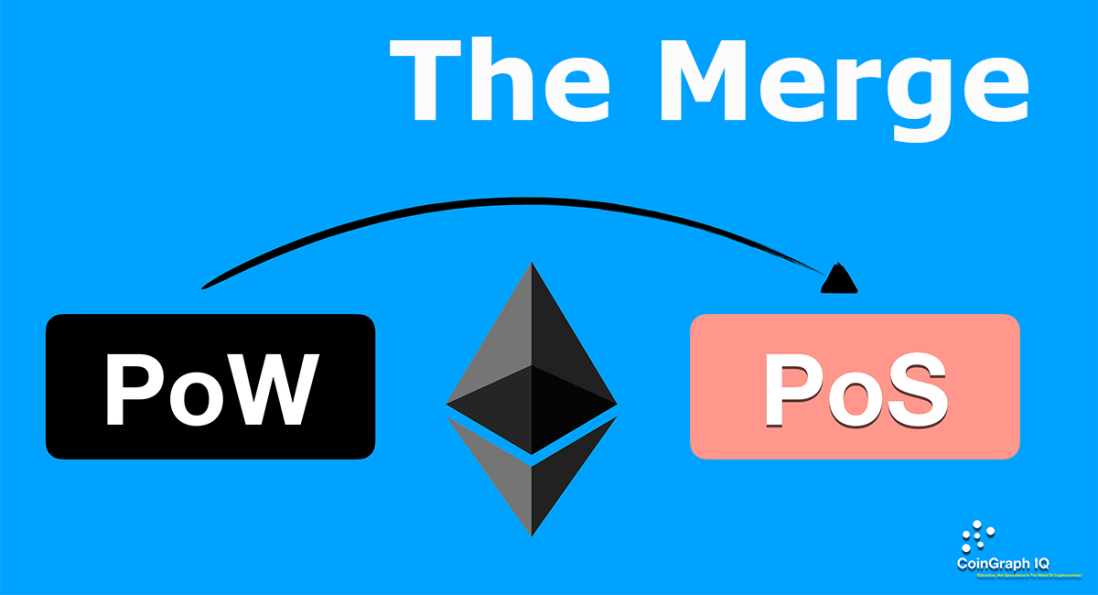
Ethereum developers have announced that they are deploying the Ethereum Merge on its blockchain on September 19, 2022 (based on transcript from a conference call). The news has been received positively by the market, which led to a rally in ETH market price. This has been a long awaited event, which will consolidate the beacon chain with the main network to transition Ethereum’s blockchain from PoW (Proof-of-Work) to PoS (Proof-of-Stake).

There have been doubts about the merge since it was first delayed in the summer of 2022. Ethereum has a known history of delaying projects, with market panic when the developers cannot deliver on time. The expectations are sometimes too high for even what the developers can accomplish. When the deliverables do arrive, it usually turns sentiment back to bullish as was the case with EIP1559.

Before the merge can become a success, there are still some hurdles to clear. Tests are underway on testnets (e.g. Ropsten) to make sure that the protocols work properly. There are still major tests that will be conducted on the Sepolia and Goerli test networks. Once these chains have been transitioned successfully without much issues to PoS, then the next step is the Ethereum mainnet. This aims to improve the network to scale the number of transactions and lower fees for users.

Although a date has been set for the merge, it is not final. If there are problems during testing that are serious enough to address, then this could lead to further delays. The hope from ETH HODLers and investors alike is for a successful merge to occur in order to increase Ethereum’s value.

Disclaimer: The information provided is for reference and educational purposes only, and is not financial advice. Always DYOR to verify information.

Ethereum Reaches A New Milestone As It Prepares For ETH 2.0

There have been plenty of great developments in the Ethereum blockchain. This has been good for its native currency ETH (Ether) and has restored confidence in holders toward the end of the first quarter of 2022. This has led to a rally in ETH price to above the $3K level, starting in March 22. Some analysts take this as an ominous sign that ETH has turned bullish once again, but what is really the motivation behind it?

Toward the end of 2021, Ethereum developers released the Kintsugi Merge test network. This is a more realistic approach to testing how the Ethereum network will be like post-merge (i.e. when the Beacon Chain merges with the mainnet). This allows developers to test the features of the network in an environment that supports PoS (Proof-of-Stake). This is where smart contracts can be tested without any additional costs to developers.

Ethereum developers have also released the Kiln public test network in March of 2022. This is the final test network before the transition to PoS. This is where developers can test their applications and tools before deploying on the mainnet. Node operators and stakers can also test on Kiln, to evaluate the performance on a simulated blockchain.

Toward the end of March 2022, the number of ETH 2.0 validators has reached 300,000+ with over $28 Billion TVL (Total Value Locked). That is based on the valuation of ETH (~$2900-$3,000 circa March 1, 2022). The total amount of ETH locked (requires 32 per validator) has reached 9.6 Million ETH. At the price of ETH in March 28, 2022 at $3,300.62 (10:46 PM EST), the total value locked would be $31.6 Billion. The value of ETH increases with the market, and any surge also brings up the TVL for the validators.

Ethereum is receiving not just retail support, but institutional as well. Macro guru Raoul Pal has become more bullish on his outlook of Ethereum. He believes it is on track to outperform Bitcoin based on its performance. Pal is looking at long term metrics that show that the market Ethereum is capturing covers a much larger base than Bitcoin. This includes the derivatives and money markets, where billions of dollars are sitting. Should even a small percentage of the money flow into the DeFi space, where ETH is a major currency, it can create network effects that can further drive ETH value higher.

Other reports are coming that banks are positive on Ethereum. It seems banks like JP Morgan had at one time been very critical of cryptocurrency. The sentiment has changed, and they now invest in projects that involve cryptocurrency like Ethereum. Perhaps the recent developments in how Ethereum will become more energy efficient and how it is a platform that facilitates a decentralized financial system opens opportunity for capital investments.

The transition to a new consensus mechanism can greatly impact Ethereum network performance. A faster and more energy efficient system gives it a positive outlook compared to Bitcoin and other energy intensive cryptocurrency that use PoW (Proof-of-Work). The more important matter that investors are keeping an eye on is how the move to ETH 2.0 will improve the network’s overall performance. This attempts to solve the problems of scaling, which Ethereum competitors (e.g. Solana, Harmony, Avalanche) have already been addressing. A more stable network with the capability to process more transactions will be huge for Ethereum, and can establish it as a dominant platform for years to come.

Crypto Takes The Spotlight At Super Bowl LVI

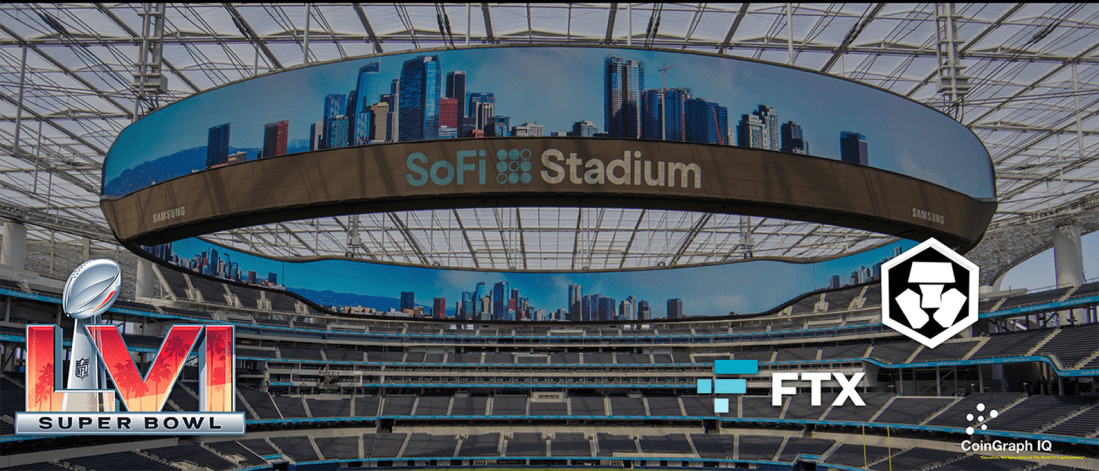
The Super Bowl is perhaps the most watched American sporting event. It is the championship game between the two best teams in the NFL (National Football League), a professional football sports organization. In 2022 it was the Los Angeles Rams against the Cincinatti Bengals, played at the SoFi Stadium in Inglewood (a Los Angeles suburb). This gave the Rams a home turf advantage in a stadium with a capacity of 70,000 but expandable to 100,240 for events like the Super Bowl. The viewership projection for the Super Bowl in 2022 comes from data analytics firm PredictHQ.  They estimate that the event will attract 117 million viewers on NBC’s network. If the international market is included that could bring figures between 125 -150 million viewers.

That is great exposure for ads, and that is the reason why many are shown during the game’s broadcast. Getting to a large target market and demographic helps keep brands relevant, and does well for marketing to new consumers. With that as a reason for advertising, the crypto (i.e. cryptocurrency) industry took the spotlight with ads  for more exposure to a mainstream audience in 2022.

In Super Bowl LVI, crypto-related fintech companies like FTXCrypto.com, Coinbase and EToro used this opportunity to release their commercials.  The market is not entirely in a boom phase quite yet. The market still has plenty of room to grow and we are at the early stages of adoption. Commercials that reach out to so many people, who actually watch them during the Super Bowl, is one way to get the message across. That is especially true for attracting new customers and crypto users. What is significant is that these companies are an important on-ramp to crypto.

The thing is, commercials for the Super Bowl need to be creative and engaging. This is probably the only time an audience will actually watch commercials because of the entertainment value it also brings during the event. Brands have learned that making their ads the most entertaining and engaging for the Super Bowl is how to capture their target market among the audience. For example we see the usual beer commercials and junk food items. Only this time with popular celebrities and public figures doing the endorsement since this adds more value and reputation to the brand. It is all about brilliant marketing with the theatrics of Hollywood.

How did the crypto ads do? I think they got the message across, but let’s be honest. Probably most of the audience have never before heard about crypto or simply do not understand or care about it. The commercials this year have become more engaging to try to make the target audience more curious and interested, at the very least. In one of their ads, FTX features Super Bowl champion QB Tom Brady (“Tom Brady Wants A Trade“). They feature a familiar face using a not so familiar app for crypto trading. Likewise, Crypto.com had their “Big Game Preview with LeBron James” commercial, as part of their “Fortune Favors The Brave” campaign.

These would be very expensive spots for even a few seconds, but perhaps it will be worth it. NBC was selling 2022 Super Bowl ads for record deals, closing at $6.5 million per 30-second commercial. Companies like FTX and Crypto.com will have no problem paying that amount. These are successful crypto exchanges earning billions in revenues who are willing to advertise. Advertising is a tried and tested formula for capturing new markets. For crypto it can help to bring in more adoption.

Spider-Man NFTs … From AMC

AMC Entertainment, the company that operates the AMC Theaters chain, has entered the NFT (Non-Fungible Token) market. In a collaboration with Sony Pictures, they will be giving away 86,000 NFTs for the December 16 release of the movie “Spider-Man: No Way Home.” This giveaway is open to members of AMC Stubs Premiere, AMC Stubs A-List and AMC Investor Connect with advance purchase of tickets.

According to AMC CEO Adam Aron (via Twitter):

This idea came from YOU! Partnering with @SonyPictures for #AMCFirstEverNFT. More than 100 unique Spider-Man NFTs, given FREE to the first 86,000 online buyers of U.S. AMC December 16 tickets for Spider-Man No Way Home. Only for Stubs Premiere, A-List & Investor Connect members.” 

— Adam Aron (@CEOAdam) November 28, 2021

This is not the first time AMC has ventured into cryptocurrency. They are already accepting payments in cryptocurrency like Bitcoin (BTC) for movie tickets. NFTs are like the next step in their journey to the blockchain and metaverse. Spider-Man is a popular Marvel Comics superhero, so an NFT would be a valuable digital collectible. This has future value for trading in the NFT marketplace among collectors. The NFT will be minted on the WAX blockchain.

This is probably part of AMCs strategy to catch up to the trends among millennials and Gen Zers. Crypto is popular among the younger generation and this is a better way to promote your brand. AMC needs to rebound after the pandemic lockdowns, so this is also a way to entice moviegoers to return to theaters with some added benefits to go along with the soda and pop-corn.

IGOs – Crypto, Metaverse, DeFi and Gaming

Launchpads to crypto gaming platforms are gaining traction. The method they use for funding is called an IGO (Initital Game Offering) that are like the ICOs (Initital Coin Offerings) in crypto and an IPO (Initial Public Offering) in traditional finance. IGOs are based on cryptocurrency like NFTs (Non-Fungible Tokens), which are issued to represent unique digital assets. NFTs can represent content like art and collectibles, which encompasses the gaming industry. NFTs issued in gaming can be in-game rewards, loot boxes, prizes and game characters. These have unique traits that determines their value. NFTs also establish ownership of a digital asset via a blockchain.

IGOs help to fund new gaming projects using launchpads like Enjinstarter. One of the big reasons IGOs are becoming popular is the rise of the metaverse. This is not the same ‘metaverse’ that Big Tech companies like Facebook (i.e. Meta) are building. Though they intersect in some aspects like with shared virtual worlds (e.g. VR, AR), the crypto metaverse is decentralized and open. Big Tech’s metaverse are like silos with their own ecosystems, but they may connect to the crypto metaverse with regards to NFTs. Other than that, there are still differences with respect to their purpose.

The use of NFTs in the metaverse is a big factor in crypto gaming projects. Developers are not just building fancy virtual world games. They are adding value to it using cryptocurrency in the form of NFTs and gaming tokens. The NFTs are the unique items users collect from playing games. Their value is based on their uniqueness, and this adds value. This can be a unique armor or weapon that gives a gamer advantages or they can be special powers. In traditional gaming these objects are also available but not tokenized like NFTs. When it is in the form of an NFT, it can be traded or sold by the gamer.

Tokens are also another feature of crypto games. Using a Play-To-Earn model (e.g. Axie Infinity), players earn the tokens from playing the game. For example, if the player wins a round, they can earn tokens as a reward for their victory. These tokens can then be put to work in DeFi protocols to earn money. This brings another aspect that is not found in traditional games, so these are enticing users to try something new.

IGOs are for investors who want to jump into a project from the start. It is an opportunity to get into what might become the next big thing in gaming. These have the potential for huge ROI (Return On Investments), depending on the amount invested. There are risks involved since the project might fail, so potential investors should do their research before participating in an IGO. A good project is one that has a great idea, but also make sure that it has a credible team and reasonable tokenomics.

It is also important to check if the project follows regulatory compliance, otherwise there could be problems in the future. This is true if the launchpad is not fully decentralized, since regulators can come after the platform’s owners.

IGOs may only be relevant until new techniques for funding replace them. For example, ICOs were eventually replaced by STOs (Security Token Offerings) and IDOs (Initial DEX Offerings) due to regulatory concerns. Those who get in early are usually the ones who benefit the most from these projects. An IGO is a great opportunity worth exploring for investors interested in earning from the next generation of gaming.

Disclaimer: This is not financial advice. The information provided is for reference or educational purposes only. Please do your own research always to verify facts.

(Photo Banner Credit: JÉSHOOTS)

The Ethereum Altair Upgrade – Merging PoS With The Beacon Chain

The Ethereum Altair upgrade was completed on October 28, 2021. This is part of the transition to ETH 2.0, as PoS (Proof-of-Stake) consensus mechanism merges with the Beacon Chain.

The upgrade implements the following:

  • light-client support to the core consensus.
  • Setup of beacon state incentive accounting.
  • Fixes validator incentives issue.
  • Penalties for offline or inactive validator nodes per EIP 2982.

Over 95% of the network participated at the time of the upgrade’s first epoch. This is the first upgrade to the Beacon Chain since going online in December 2020 and could also be the last before the merge with PoS on the Ethereum mainnet.

According to IntoTheBlock researcher Lucas Outumuro:

Through the Altair upgrade, Ethereum sets the base for this vision, enabling the upcoming merge of the proof-of-work chain and the Beacon Chain. Finally, these are expected to benefit Ether holders and stakers by making it deflationary while offering higher returns to validators.”

The recent London Hard Fork had introduced a base fee as part of EIP 1559 with a coin burning mechanism that adds a deflationary feature to Ethereum. During the first 48 hours of that upgrade, $30 million in ETH were burned from the network’s circulation. As of 10/30/21, 681,030 ETH have been burned that is valued at $3,013,073,269. This puts pressure on supply as it decreases and drives the price of ETH higher due to market demand.

With ETH 2.0 set for deployment in 2022, Altair is part of the preparation. Altair is a hard fork, which means that the 250,000+ validator nodes who didn’t upgrade are now considered offline. Their ETH will then slowly diminish at about 10% per year. This was included in Altair as a sort of way to push for moving towards the upgrade. This not only benefits the validators, but the network as a whole as it comes to an agreement to pave the way for Ethereum’s next phase.

VISA Gets Into NFT With CryptoPunks

VISA has announced the purchase of a CryptoPunk NFT (Non-Fungible Token) worth approximately $165,000 (~50 ETH this August 18, 2021). Perhaps the most unlikely thing you would expect VISA (the financial credit company) to invest in. VISA is apparently bullish on NFTs, or could this just be another signal to show they are “in the know” or “part of the gang”? CryptoPunk NFTs are original digital artwork made by Larva Labs. These are unique collectible characters that have verified ownership on the Ethereum blockchain. They are not physical objects at all, but purely digital. They look just like icons or emojis, not at all like the works of art you would see in a gallery.

This shows that VISA is getting in on the DeFi (Decentralized Finance) market with NFTs. According to their recent tweet:

“Over the last 60 years, Visa has built a collection of historic commerce artefacts—from early paper credit cards to the zip-zap machine. Today, as we enter a new era of NFT-commerce, Visa welcomes CryptoPunk #7610 to our collection”

NFTs like CryptoPunks, despite looking like mediocre art, hold plenty of value. A typical CryptoPunk can bid over $20,000 while the more in demand will bid in the millions of dollars. That shows that there is a big market for these collectibles and the buyers have plenty of money to spend. This is not your basic retail market where items cost a few dollars. This is a big money market, and it has attracted VISA’s attention.

What makes CryptoPunks desirable as a collectible is their uniqueness. A CryptoPunk character (i.e. Punks) is algorithmically generated by computer, not manually created by a human artist. There are also different types like Apes, Zombies and Aliens. Each CryptoPunk character has their own set of attributes and their metadata are recorded on the Ethereum blockchain. That also includes the proof of ownership to the holder of the NFT.

It seems like VISA will hold this NFT for the collection purposes. It will hold the CryptoPunk for historical records, perhaps to document a time when NFTs first emerged. This will surely be valuable in the future, whether NFT continue to become successful or not. Just owning a piece of history is valuable in itself, so VISA is going to look back on this as having a memento to that timeline. Overall the NFT market continues to grow. According to Forbes, the NFT market grew 1,785% In 2021. It is now the fastest growing sector in DeFi that is also gaining pop culture adoption and VISA is jumping on board.

Moving forward, it looks like VISA is also on the horizon ready to enter new partnerships and projects related to NFTs. As a payment processor, VISA can help bridge the traditional finance market with the DeFi space. That opens a world of opportunities for buyers, sellers and developers.

London Hard Fork Brings The Burn To Ethereum

The Ethereum network has activated the London Hard Fork successfully (12:34 UTC, Block# 12,965,000, 8/5/2021). In the first two days, $30 Million of ETH (Ether) were burned. That amount of ETH burned, removes approximately 3,000+ ETH from circulation. This is part of the EIP 1559 specification in which a certain portion of the transaction fee is burned per transaction. The hard fork also makes transaction fees on the Ethereum blockchain more predictable. This creates lower gas fees that can bring the costs of transactions down since there is now a base fee.

The introduction of a base fee addresses the volatility in transactions. This is regarding the cost of gas prices during times of network congestion. When the network is at its busiest, the cost of gas can suddenly increase which is why recent transaction costs on the Ethereum network has been high. With a base fee, this can prevent gas prices from suddenly shooting up to levels where it makes more sense to send large transactions than lower ones.

Since Ethereum uses an inflationary currency model, the burning introduces a deflationary system for the first time. This puts a check on the amount of ETH in circulation, which can affect prices to the upside. This has become controversial since it affects miner rewards, but the Ethereum network is moving away from mining (Proof-of-Work) consensus. A protocol difficulty bomb is part of the design for Ethereum 2.0 (ETH2.0) that will make mining more difficult, encouraging validators to move towards staking (Proof-of-Stake) consensus. The London Hard Fork will delay this at the moment to allow time for transition.

In a nutshell the London Hard Fork has enabled the following features:

  • Establish a base fee for transactions
  • Provide more transparency and predictability to transaction fees
  • Make ETH a more deflationary asset with a burning mechanism

Here are other EIPs activated during the London Hard Fork:

EIP 3554 delays the “difficulty bomb”.

EIP 3529 reduces gas refunds. Gas tokens (e.g. Chi) will become obsolete.

EIP 3198 allows users to return the base fee opcode.

EIP 3541 enables future upgrades to the Ethereum Virtual Machine (EVM)

Overall this introduces steps that will bring Ethereum closer to a minerless future. This gives time for miners to transition to staking, but once the difficulty bomb is activated it begins the “Ice Age” for mining. The new structure for transaction fees is also a positive development in light of the skyrocketing costs to run a transaction on the Ethereum blockchain. It doesn’t exactly lower gas prices, but makes it more manageable with a base fee. At least users will not have to deal with sudden increases when all they want to do is transfer ETH to another wallet or swap tokens. ETH will also be headed towards a more deflationary asset as well, with the burning of portions of its transaction fees. All of this creates positive market signals that drives further utility on the Ethereum blockchain.

(Photo Credit by Chris Schippers)

Ethereum Berlin Is Here, Next Stop Is London

The Ethereum blockchain has implemented the Berlin hard fork at block 12,244,000 this past Thursday (April 15, 2021). This was not the anticipated Optimism Rollout yet, but instead are a set of improvement proposals to help the network with gas costs and security.

Berlin was supposed to implemented in 2020, but as with most Ethereum projects it got pushed back. There were centralization concerns around the Geth client on which most Ethereum nodes operate. An important feature of Berlin is the live swapping of Ethereum from a proof-of-work to a proof-of-stake blockchain.

Other important features of Berlin are optimizations for smart contracts including gas efficiency, updates to EVM code and protection against DDOS attacks.

The upgrade implements the following:

  • EIP-2565, reduces gas cost for a specific transaction type that uses modular exponentiation.
  • EIP-2718, makes all transaction types “backwards compatible” using so-called “envelope transactions,” which allows the addition of new transaction logic into Ethereum.
  • EIP-2929, increases gas costs for “op code” transactions, a pain point for denial of service attacks on Ethereum in the past.
  • EIP-2930, a new transaction type (made possible by EIP-2718’s envelope transactions) which allows its users to create templates for future, complex transactions in a bid to lower gas costs.

The upgrades are in line with the bigger upgrade that will introduce EIP 1559 called London.

VISA Forges New Connection Between Fiat And Cryptocurrency

Payments giant and credit card company VISA, have announced they are providing support for cryptocurrency payments using the USDC stablecoin starting with partner Crypto.com. USDC is an ERC-20 token that runs on top of the Ethereum blockchain network. This makes use of a stablecoin to settle payments using VISA payment products through their partners. At the moment VISA will pilot the payment system with Crypto.com, a cryptocurrency platform and digital exchange, with plans to offer the service to other partners. VISA is going to make using cryptocurrency much more available for payments. This legitimizes cryptocurrency payments for goods and services, since VISA is a financially regulated entity.

This is a bridge between traditional finance with emerging fintechs involved with cryptocurrency and digital assets. VISA had tried to bridge cryptocurrency payments before, but plans fell through. Perhaps VISA is now ready to provide the service with more knowledge and understanding of cryptocurrency. This allows VISA to better understand the new space fintechs are operating from, which involves innovative products that implement digital currency and blockchain technology. Perhaps it is a sign that changes are coming to traditional financial systems. VISA has been warming up to cryptocurrency and other digital currency (non-crypto) as evident from their more recent postings.

Before VISA, payments processors like PayPal and Square have provided support for cryptocurrency. PayPal has paved the way for users to buy cryptocurrency like Bitcoin through their app. Square allows their customers to buy, hold and sell cryptocurrency through their platform, including the Cash app. Prior to that, there were not many mainstream apps other than those provided by digital exchanges like Coinbase that allow their users to purchase cryptocurrency. VISA is different in that it is providing a way for customers to make payments with the cryptocurrency they hold. This is a layer that has been missing and it could accelerate utility of cryptocurrency as a payment method. Using the blockchain may also provide faster settlements compared to the current system, but scaling remains to be seen on blockchain networks like that of Ethereum.

While the purpose of cryptocurrency is for open direct payments system (Peer to Peer), VISA is not exactly that type of platform. It still operates under the traditional financial system, which is highly centralized and permissioned. That means VISA is not exactly an open network, it requires a membership for its customers. That is why the product they offer is more of a bridge between the traditional fiat system and cryptocurrency. The decentralized aspect of a transaction still falls under the blockchain layer, but through a VISA payment gateway. In the case of USDC, the payment is from a user’s digital wallet on the Ethereum blockchain or even a custodial wallet that supports USDC. What VISA provides is a way to make that payment possible to retailers who will accept the transaction. VISA has so many partners in the retail space that they work with, this opens opportunities for cryptocurrency companies like Crypto.com to have access to more traditional financial markets.

VISA could also open another bridge, this time to the DeFI space of the blockchain. Most platforms in DeFi run over the Ethereum network, but other platforms like Binance, Polkadot and Cardano offer their own ecosystems that provide DeFi apps. If there is integration to support VISA, that can bring more users to the DeFi space who are using VISA credit cards or payment applications supported by the VISA network. At the moment, VISA and other credit card companies do allow customers to purchase cryptocurrency from digital exchanges. Opening up to support decentralized exchanges in the DeFi space are more challenging due to regulatory compliance. If this can be resolved, it opens up the space to allow interoperability of dissimilar payment networks to become possible.

This is overall good for the Ethereum network. VISA will not only need to have USDC, but also Ethereum’s native token ETH (ether). In order to process transactions using USDC, small denominations of ETH are used to pay for costs called “gas” which are part of the transaction fees paid to the network. This is for processing transactions that have to be verified and secured on the blockchain. It may also be likely that it will be VISA’s partners who hold the USDC and ETH, while VISA just helps bridge the retail merchants with the cryptocurrency payment as the settlement layer. The main issue with Ethereum has been scaling, but the development community is fast tracking efforts to scale the network.

With VISA’s announcement, other payment companies like Mastercard and American Express should take notice. This introduces a business model that brings cryptocurrency native platforms with the traditional retail space. The predominant form of payment in the VISA network is by credit and debit card. By integrating a cryptocurrency method into the network, it opens up new channels for making payments. The choice of using a stablecoin also makes plenty of sense given that cryptocurrency is very volatile. This changes the narrative that cryptocurrency is trying to replace traditional finance. Before that can happen, it must have greater utility. Perhaps VISA can help bring it to more mainstream adoption, to the point where we can buy toilet paper with cryptocurrency.

(Image Credit: Photo by Tom Fisk)