Binance is offering a new financial instrument on its digital exchange. They are offering a way to purchase fractions of a company’s shares using a tokenized stock trading service. This will provide stock traded equities in financial markets for investors. Binance will begin with Tesla stock on their exchange. The instrument is called a Binance Stock Token, and this allows users to buy a stock or a fraction of a share and earn dividends as well. The prices will be settled in Binance’s BUSD stablecoin token.
For users who have no access to financial markets, they now have an opportunity to own as little as 1/4 of share in an equity like Tesla (TSLA). There is no more need to purchase several stocks when you can have just a fraction and earn from it. This gives exposure to the non-traditional crypto investors who don’t have to wait for other platforms to offer the service.
S = Shares of A Stock p = Price of the Stock b = BUSD
b = S(p)
The user will purchase the stock in BUSD prices (b).
Binance claims that they are not creating synthetic assets to offer as stock. They have an asset that is backed by a depository portfolio of underlying securities, which is also managed by a German investment firm. In order to follow compliance, the service is not available to all jurisdictions and only where the exchange is allowed to offer such a service. Those interested will definitely be required to submit a KYC/AML document for legal purposes.
Two things that I can expect to see:
Increase in BUSD trading as a result of the tokens use for investing in stocks. BUSD prices will not surge because it is pegged 1:1 with the USD.
Open up the stock market to first time investors who have never had exposure to equities. This allows users who were either not allowed to trade because of lack of funds or not have access to stock investments to get their chance.
It is interesting to note if other DeFi products will follow that can interact with the Tesla stock. Binance also has its native Binance Smart Chain(BSC) which uses smart contracts that can lock tokenized stocks in a different protocol and earn from it. Some DeFi protocols may even accept tokenized stocks as collateral, depending on how valuable it is in the market.
This can also further boost Tesla stock prices as it has seen a phenomenal surge. Binance can gain more investors while helping bring Tesla stocks higher. While the trends look good for Tesla, investment always involves risk so users must do their due diligence and research always before investing.
Disclaimer: This is not financial advice. The information provided is for educational and reference purpose only, not for making investments. Do your own research always.
Payments giant and credit card company VISA, have announced they are providing support for cryptocurrency payments using the USDC stablecoin starting with partner Crypto.com. USDC is an ERC-20 token that runs on top of the Ethereum blockchain network. This makes use of a stablecoin to settle payments using VISA payment products through their partners. At the moment VISA will pilot the payment system with Crypto.com, a cryptocurrency platform and digital exchange, with plans to offer the service to other partners. VISA is going to make using cryptocurrency much more available for payments. This legitimizes cryptocurrency payments for goods and services, since VISA is a financially regulated entity.
This is a bridge between traditional finance with emerging fintechs involved with cryptocurrency and digital assets. VISA had tried to bridge cryptocurrency payments before, but plans fell through. Perhaps VISA is now ready to provide the service with more knowledge and understanding of cryptocurrency. This allows VISA to better understand the new space fintechs are operating from, which involves innovative products that implement digital currency and blockchain technology. Perhaps it is a sign that changes are coming to traditional financial systems. VISA has been warming up to cryptocurrency and other digital currency (non-crypto) as evident from their more recent postings.
Before VISA, payments processors like PayPal and Square have provided support for cryptocurrency. PayPal has paved the way for users to buy cryptocurrency like Bitcoin through their app. Square allows their customers to buy, hold and sell cryptocurrency through their platform, including the Cash app. Prior to that, there were not many mainstream apps other than those provided by digital exchanges like Coinbase that allow their users to purchase cryptocurrency. VISA is different in that it is providing a way for customers to make payments with the cryptocurrency they hold. This is a layer that has been missing and it could accelerate utility of cryptocurrency as a payment method. Using the blockchain may also provide faster settlements compared to the current system, but scaling remains to be seen on blockchain networks like that of Ethereum.
While the purpose of cryptocurrency is for open direct payments system (Peer to Peer), VISA is not exactly that type of platform. It still operates under the traditional financial system, which is highly centralized and permissioned. That means VISA is not exactly an open network, it requires a membership for its customers. That is why the product they offer is more of a bridge between the traditional fiat system and cryptocurrency. The decentralized aspect of a transaction still falls under the blockchain layer, but through a VISA payment gateway. In the case of USDC, the payment is from a user’s digital wallet on the Ethereum blockchain or even a custodial wallet that supports USDC. What VISA provides is a way to make that payment possible to retailers who will accept the transaction. VISA has so many partners in the retail space that they work with, this opens opportunities for cryptocurrency companies like Crypto.com to have access to more traditional financial markets.
VISA could also open another bridge, this time to the DeFI space of the blockchain. Most platforms in DeFi run over the Ethereum network, but other platforms like Binance, Polkadot and Cardano offer their own ecosystems that provide DeFi apps. If there is integration to support VISA, that can bring more users to the DeFi space who are using VISA credit cards or payment applications supported by the VISA network. At the moment, VISA and other credit card companies do allow customers to purchase cryptocurrency from digital exchanges. Opening up to support decentralized exchanges in the DeFi space are more challenging due to regulatory compliance. If this can be resolved, it opens up the space to allow interoperability of dissimilar payment networks to become possible.
This is overall good for the Ethereum network. VISA will not only need to have USDC, but also Ethereum’s native token ETH (ether). In order to process transactions using USDC, small denominations of ETH are used to pay for costs called “gas” which are part of the transaction fees paid to the network. This is for processing transactions that have to be verified and secured on the blockchain. It may also be likely that it will be VISA’s partners who hold the USDC and ETH, while VISA just helps bridge the retail merchants with the cryptocurrency payment as the settlement layer. The main issue with Ethereum has been scaling, but the development community is fast tracking efforts to scale the network.
With VISA’s announcement, other payment companies like Mastercard and American Express should take notice. This introduces a business model that brings cryptocurrency native platforms with the traditional retail space. The predominant form of payment in the VISA network is by credit and debit card. By integrating a cryptocurrency method into the network, it opens up new channels for making payments. The choice of using a stablecoin also makes plenty of sense given that cryptocurrency is very volatile. This changes the narrative that cryptocurrency is trying to replace traditional finance. Before that can happen, it must have greater utility. Perhaps VISA can help bring it to more mainstream adoption, to the point where we can buy toilet paper with cryptocurrency.
An issue with Ethereum is about to be addressed regarding its non-capped supply of ETH (Ether) with EIP 1559. The proposal aims to introduce a new protocol for addressing the transaction fees on the network targeted for release in July/August 2021. In the proposed change, during a transaction a small amount of Ether (ETH) is “burned” every time it is used to pay for gas fees. This token burn can somehow control the circulating supply of ETH as well, leading to a more deflationary money supply. The burned tokens are removed from circulation forever but new ones can still be created. Overall, this can add some controls on the amount of ETH being put out in circulation as form of inflation control.
Transaction fees are not consistent on the Ethereum network. They fluctuate every so often, but when there is high network demand the fees surge to sometimes ridiculous levels. For the seasoned trader it may not matter, but for retail and new traders it can be too much for smaller sized transactions. More experienced traders may deal with large transactions where the cost of gas does not matter as much. The prices are still high and there needs to be some improvement in which issues like scaling and layer 2 solutions aim to resolve.
TxFee = Total Gas Used * Gas Price Paid
As of March 7, 2021, the average cost of a transaction is $15.53. Just a few months earlier on January 17, 2021 the transaction fee was only $5.41. That goes to show a sudden increase of 187%, which could have been worth at least 2 transactions back in January or earlier in 2021. The demand for ETH in the DeFi space and hodling portfolios due to the good news coming out about ETH2.0 is helping to drive prices and at the same time increasing network activity. The congestion is expected, as the same thing happened back during the cryptokitties and ICO era. This puts plenty of strain on the network, but it has problems scaling since it can do at most 15 tps (transactions per second). The promise of ETH2.0 is a bring faster consensus with more efficiency through a staking protocol (i.e. Proof-of-Stake) to scale the network.
EIP 1559 is an improvement proposal to help make transaction fees more consistent and prevent it from getting to such high levels that many are not willing to pay. Currently with Proof-of-Work, the miners can determine the fees and increase it in order to prioritize a transaction. Nodes called miners set the price of gas used to process transactions, based on the supply and demand of computational resources available from the network. It is in units called Wei or Gwei, just smaller denominations of ETH. The proposal is to use what is called a BASEFEE, that is set based on the network’s level of transactions. What it aims to provide is a market rate rather than a reference based on prices that users are paying for. This structure eliminates the guess work often involved in calculating the transaction fees.
Some see this as adding deflationary measures because of the token burning feature. As tokens are created, they are also destroyed. That keeps the circulating supply in check and prevents any inflationary pressure, according to some analysts. This form of negative inflation could lead to less ETH in circulation, thus increasing market price. While this looks good to traders and core developers, some miners don’t exactly agree with the proposal. They don’t derive the same benefit as much since the token burn benefits token holders more than miners. The miners lose out on their profits that would have been the burned tokens.
The outcome may push for EIP 1559 despite the protests. Ethereum plans on moving away from mining and into staking, so it does make more sense to implement the protocol rather than continue with the current system. Mining will also become more difficult as specified in the protocol for ETH2.0 (e.g. difficulty bomb), that nodes would rather switch to staking since mining will be less profitable until it is totally no longer possible due to the increase in difficulty level. That leads to questions about whether the miners will hard fork Ethereum, but that may be a horrible idea. If no one supports the fork then the miners have a lot to lose, while the mainnet remains profitable with new nodes entering the network. EIP 1559 will surely be activated with > 50% consensus, but the miners can signal a no to the network and not activate it. What is important that still needs to be addressed are the high transaction fees, The hopeful resolution is that the miners and developers come to some agreement to determine transaction fees which really needs to be addressed to further the momentum of growth on the network.
A digital exchange in the Philippines called PDAX sold Bitcoin (BTC) for $6,000 or roughly worth PHP288,000 (in Philippine Pesos). This comes from a report from Bitcoin.com (link here) about an incident that occurred in the middle of February 2021, amidst Bitcoin reaching new all time highs. Some users on the PDAX exchange noticed that BTC was selling for $6,000. That was at a time the rest of the market was selling BTC at prices over $50,000, so this was almost like a steal. Perhaps that was the way PDAX saw it because they are now asking for their Bitcoin back. It appears that there was a system glitch that caused an error when listing BTC prices. The exchange had also experienced an outage due to a surge in volume of network activity.
It sounds crazy to think that you can reverse transactions with Bitcoin. You won’t be able to because the blockchain is immutable and not modifiable. You cannot undo a transaction once it has been committed on a blockchain. According to the report, the exchange is requesting the users to return their BTC or else they will face legal action. Some accounts were even locked to prevent them from further activity. How can you force the users to return something they bought legally, which by all means was compliant to the rules and regulations set forth?
In all of this, the one thing that has been proven is that the blockchain does work the way it was intended. If the blockchain could be manipulated, then PDAX would have reversed the transactions already and this would probably not be reported. Users will lose the BTC they bought at $6,000 but will get a refund from the exchange. Instead, the blockchain secured the transaction and proved that it was allowed by PDAX. The BTC the users purchased can also not be confiscated by any entity because BTC requires the private key of the owner. It can be forcibly taken, but that would still require a user to grant access to their BTC through a digital wallet.
The users merely used the exchange to make their purchase and go about their way. This is how a blockchain is supposed to work and to think otherwise goes against the basic principles of Bitcoin and cryptocurrency. How this case ends up is something to follow because we shall see how things unfold. Can an exchange require users to return digital assets due to unusual activity or are transactions on the blockchain final? I would like to think the latter but we shall see if further investigations reveal anomalies or will the ruling be in favor of the users.
You can take two good things and combine them together to get the best of both. In LA’s streets you can get what some would consider one of the city’s iconic sandwiches. It is the hotdog wrapped in bacon. It brings you the meaty flavor of a hotdog with the greasy goodness of bacon. Now think about the top digital asset Bitcoin (BTC). What would you wrap it with if you were to compare it to a hotdog wrapped in bacon? How about Ether (ETH), the Ethereum blockchain’s token. BTC is your hotdog, while ETH is your bacon. It actually exists and it is called Wrapped Bitcoin (WBTC).
Wrapping one cryptocurrency with another uses the hotdog wrapped in bacon example as a simpler way to illustrate an analogy. Wrapping in this sense means to create a protocol to represent one cryptocurrency on another cryptocurrency’s blockchain. BTC can be represented on the Ethereum blockchain by issuing an ERC-20 token called WBTC. This allows BTC integration with smart contracts that can be traded on the Ethereum network using the ERC-20 standard.
In Wrapped Bitcoin, BTC is locked into a smart contract and issued as WBTC. This allows BTC holders to access DeFi systems on the Ethereum blockchain. It is as good in value as BTC which is verified by a Proof-of-Reserve system. This ensures a 1:1 peg between the issued or minted WBTC tokens and BTC. The actual BTC is still on the Bitcoin blockchain since you cannot store it on the Ethereum blockchain. The BTC is taken under the custody of the WBTC token issuer, so it is not directly with the WBTC token holder. It is maintained by a group called the WBTC DAO, who are the custodians of the BTC. The group’s members include blockchain-based organizations like BitGo, Ren and Kyber.
What is the purpose of WBTC?
As mentioned earlier, it is primarily for giving BTC holders a way to gain access to the DeFi markets. A large portion of the DeFi space uses the Ethereum blockchain and BTC is not directly compatible with it. It is a bridge that allows BTC holders to use DeFi protocols to provide liquidity or participate in other services that yield returns. WBTC is a way to bring the value from BTC into the DeFi space without having to convert BTC to ETH. BTC (as of 2020) has the largest cryptocurrency market cap and this is crucial in helping bring liquidity to the DeFi space as well as expanding on the collateral types available.
This is a great way for BTC holders to take part in the DeFi markets. Many BTC holders have plenty of value stored, but are not able to use it if they are HODLing. DeFi provides ways for cryptocurrency to earn even while HODLing, using decentralized protocols like Uniswap, Curve and Yearn. Most DeFi protocols will only support ERC-20 or ETH since they execute from smart contracts on the Ethereum blockchain. WBTC is a protocol that allows BTC to be wrapped in an Ethereum ERC-20 token. Holders would not need to convert their BTC to ETH during this process.
Minting WBTC
To enter the DeFi space, Bitcoin holders would have to deposit their BTC into a smart contract of a WBTC issuer (e.g. BitGo, Coinsquare, etc.). This can be a digital exchange or DEX (Decentralized Exchange) that accepts BTC. Once the BTC has been deposited, WBTC tokens are minted that have a 1:1 value to the BTC that was deposited. Once the holder receives their WBTC, they can now use it for loan collateral, providing liquidity and swapping for other tokens. Digital exchanges will most likely require a KYC (Know Your Customer) in compliance with the law before the WBTC can be issued. On a DEX or over-the-counter it is not required (check with the exchange requirements always). The WBTC can be cashed out to either BTC or ETH.
Another way to get WBTC is through a DEX like Uniswap. Instead of depositing BTC into a smart contract, anyone who holds ETH can purchase WBTC. It requires connecting a digital wallet like Metamask to perform the transaction with ETH. The WBTC is already available in the market and it does not require BTC for purchase in this case. Since WBTC is an ERC-20 token, it can be purchased with ETH very easily.
Other Uses For WBTC
WBTC can be put to use in DeFi yield farming protocols. This allows WBTC holders to put their digital asset for lending and trading purposes. In return, the WBTC holders earn yields as a their return on investment. These yields are fees collected from the transactions. Rewards can be issued in the form of governance tokens, which allow the holders to participate in digital governance through voting. This provides holders a way of participating in decisions that govern these protocols.
Yield farming requires the holders to deposit their WBTC. In return, they are issued another token. Examples of these tokens include SNX (Synthetix token), REN (Ren Project token) and BAL (Balancer token). The tokens are specific to which protocol is used by the yield provider. To learn more about yield farming, there is an article on Coindesk that explains it a little bit further. (Link here)
The Best Of Both
Wrapped Bitcoin brings the best of two blockchains. It is a way to interoperate between two digital assets at the protocol layer. The value of Bitcoin and the decentralized applications on Ethereum. BTC is the digital asset while ETH is the protocol that utilizes it for liquidity, trades and financing. The Ethereum blockchain is serving as a transaction layer that can bring more capital into diverse markets. Bitcoin can provide the capital, as institutional investment grows in the digital asset. WBTC provides a way for investors to bring capital for yielding returns using the Ethereum blockchain.
Disclaimer: This is not financial advice, just reference. Do your own research always to verify information.
The Ethereum blockchain has undergone significant updates in preparation to a new version. The following software updates have been made since the project first started:
Frontier (July 2015) Homestead (March 2016) Metropolis (Byzantium in October 2017 and Constantinople in February 2019) Istanbul (December 2019)
The next iteration is Eth2 or Ethereum 2.0 which will introduce the Serenity update. It is set to begin in late 2020 and deploy in phases. (Learn more at Ethereum.org)
It will change the Ethereum protocol, moving away from the Proof-of-Work (PoW) consensus mechanism to Proof-of-Stake (PoS). It will launch in multiple phases, as developers begin deploying the necessary changes to the Ethereum blockchain. The main purpose for this transition is to bring more efficiency and scalability to the network, to process more transactions and operate with more efficiency and stability. Scaling has long been a problem of blockchain-based networks, because they have to rely on decentralization which doesn’t process transactions as efficiently at the rate of commercial business applications. That is part of a tradeoff with scalability, since blockchains are more decentralized and secure.
Eth2 will still be decentralized, but improve their consensus mechanism from mining to staking. This will allow validators to contribute based on their proportion of ETH (ether) on the network rather than providing compute resources. There is no more need to solve random puzzles using hash power. Instead the staking method allows validators of blocks to commit a portion or all of their ETH to validate transactions. Their incentive will be based on the amount they staked. It is more energy efficient as well, not requiring expending large amounts of energy to produce one block. Eth2 randomly selects validators in a fair and decentralized manner.
At present, the Ethereum network can process between 15 to 30 tps (Transactions Per Second). With Eth2 it will increase the transaction velocity up to 100,000 tps. This would be possible (in theory) with the implementation of the Ethereum 2.0 upgrades. Even if in the real world it isn’t exactly 100,000 tps, a higher transaction velocity is still the best outcome. The underlying element to increase the number of transactions involves the use of shard chains (sharding will be explained later).
Among other changes to the network, the beacon chain and sharding will also be deployed as part of the EIP (Ethereum Improvement Proposals). Beacon chain is a feature that coordinates the PoS implementation on the Ethereum blockchain. Sharding aims to improve the storage of data on the network, to scale to higher capacity and faster access to data. Rather than to have all nodes on the network storing the blockchain state, shards are created to store system state in a distributed and decentralized manner for more efficient operations. If all nodes had to keep store of the world state of the blockchain, it certainly slows down the network since each node has to perform updates whenever there are changes. That can take plenty of time when you have many nodes.
The idea is to keep the network open to all who want to stake without barriers in order to maintain a decentralized network. Ethereum 2.0 will require 16,384 validators, which means a more decentralized and secure network. The more nodes there are, the more security to the network through coordinated participation of each node. This is because those who have staked their ETH face losing what they staked if they do not cooperate with other nodes or if they attempt to attack the network. It is a coordinated game theory example of contributing resources for the greater good. However, there are also consequences and not just incentives.
Despite all the efforts by developers, the project has been facing delays. This is not a major setback, but has been expected due to the complex nature of the system. It has been in development for years and it could still take longer to deploy and implement. It does keep the momentum for driving the value of ETH higher, along with the surge in the DeFi (Decentralized Finance) space which is based on Ethereum’s ERC20 token standard. As transaction volume increases and ETH gas costs decrease, the value of ETH would show a likely bullish trend. The market is so volatile though, nothing is certain. The transition to Ethereum 2.0 will be undergoing phases, so they won’t happen over night. It is best to keep an eye out on the developments, because any progress would surely be a good signal to the rest of the market.
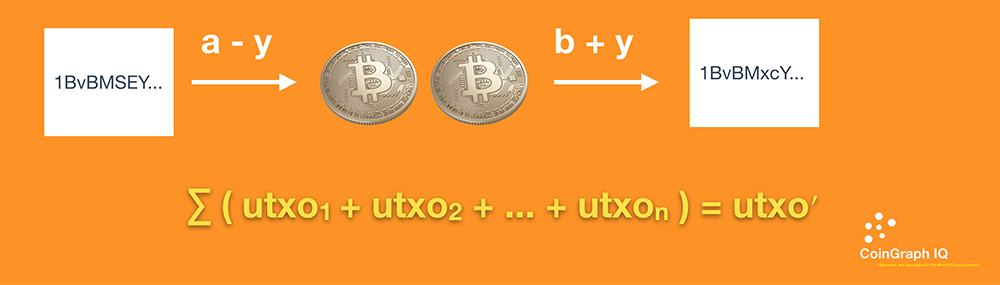
Bitcoin uses the UTXO (Unspent Transaction Output) accounting model for processing transactions. In Bitcoin, a user’s balance is indicated by the unspent amount of BTC that is recorded on the blockchain. A user’s input to a transaction is the output from the last transaction. If the user has no previous transaction, then the input is the output from another user’s transaction. These are processed continuously and written to the blocks which are added to the main chain for immutability. Every transaction on the Bitcoin blockchain has an input and output to prove the transfer and ownership of a digital asset.
There is a misconception that digital wallets store the digital assets. That is actually not the case since the digital assets are always stored on the blockchain. They are just values that indicate the balance or quantity and the ownership by a private key. The digital wallet is really an application that provides users access to their digital assets on the blockchain via a private key. The wallet also contains the public address, which is used to identify the user to the blockchain. Once the wallet is opened, the users can see their digital assets from the blockchain. In Bitcoin, the BTC is always stored on the blockchain. The information is accessed by the user from their wallet with authorization from their private key. Without the private key, a user will not be able to access the information. The private key also creates a digital signature which authorizes a user to send their BTC to another user as a way to transfer the ownership of the digital asset.
When the digital asset is transferred, it is recorded as an output O from the sender. It is then the new input I to the user it was transferred to. It has to always be an input/output relationship for provability. The transactions can be referenced by cryptographic hashes that is called the TxHash (Transaction Hash). Users can view this information on a blockchain explorer like blockchain.com/explorer. The best way to understand this is that inputs reference outputs when making transactions on the Bitcoin blockchain.
Key concepts to understand:
Each input to a new transaction was the output from a previous transaction, which can be referenced by a TxHash.
Each output was the result of a transaction from a spent amount.
The input from an output is considered an unspent amount.
All unspent amounts are considered the balance of the digital asset the user owns.
The spent amounts become the unspent amounts of other users who received the digital asset.
Only unspent outputs can be used as inputs to a transaction in a Bitcoin network.
The sum of all unspent outputs is the total balance available to the user.
Let’s take an example.
Bob wants to pay Alice 5 BTC. Bob has a balance of 100 BTC, while Alice has 30 BTC. According to the protocol, the sender is Bob and the recipient is Alice. Both users have a Bitcoin public address, which is a hexadecimal string. The public address is like the e-mail address, it allows users to identify other users for sending digital assets. Bob will send the 5 BTC to Alice via her public address.
Here is how the process works:
Bob unlocks his unspent outputs using his digital wallet to send 5 BTC to Alice.
Bob’s UTXO of 100 BTC is his input to the transaction. Once Bob indicates from his wallet that he only wants to send 5 BTC to Alice, the 5 BTC is deducted from the 100 BTC. (100 – 5)
The 5 BTC are sent to Alice’s address and the remainder of 95 BTC are sent back to Bob.
Alice’s balance is increased by 5 BTC (30 + 5) for a total of 35 BTC.
This is a simplified overview of how the process works. In reality, the transaction must undergo confirmations in order to be validated to the blockchain. This is another mechanism that uses the PoW (Proof-of-Work) consensus algorithm.
Bob’s output (95 BTC) from the transaction will become his input to his next transaction. Multiple transactions can occur on the network at the same time. Suppose that Carol wanted to pay Bob 20 BTC at around the same time that Bob was sending 5 BTC to Alice. This is possible since transactions can run in parallel, though they are still processed in sequence. While Bob’s transaction with Alice has a UTXO of 95 BTC, Bob’s transaction with Carol is a UTXO of 20 BTC.
Bob’s total balance is the sum of all his UTXO,
∑ ( utxo1 + utxo2 + … + utxon ) = utxo’
where n is the last term of the UTXO. In our example Bob’s total balance would be:
Total Balance = 95 BTC + 20 BTC = 115 BTC
Using blockchain analytics, all of Bob’s transactions can be viewed based on the TXHash. This contains information like the block number, number of confirmations and total fees.
On another note, the sum of the UTXO between Bob and Alice must not change. Before the transaction Bob had 100 BTC and Alice had 30 BTC.
100 BTC + 30 BTC = 130 BTC
At the end of their transaction, not including other UTXO, the sum must still be 130 BTC.
95 BTC + 35 BTC = 130 BTC
If the amount remained the same for Bob after he sent 5 BTC to Alice, then this is an example of a “double spend”.
100 BTC + 35 BTC = 135 BTC
The amount of 135 BTC is not correct since 5 BTC was spent from Bob’s UTXO. It should remain balanced at 130 BTC.
UTXO allows the Bitcoin blockchain to keep track of a user’s balance. Every BTC spent becomes a UTXO for another user. It also helps to prevent “double-spending” of a digital asset through a system of confirmations to verify the UTXO exists. The confirmations are possible because the UTXO is read by nodes on the Bitcoin network for validation. When there is a consensus among the nodes on the network that the UTXO is valid and has not been spent on another transaction, it is recorded on the blockchain. Once it is recorded, the data cannot be modified, changed or deleted unless there is a majority consensus to do so. This means no single entity can reverse or commit a double spend of the same transaction (Note: The exception is if they have the majority control (e.g. hash power), which requires at least 51% of the network). The transfer of ownership of BTC is thus concluded in the transaction.
The DeFi space is notorious for copycat blockchain projects which don’t really deliver anything useful other than a quick pump and dump. Those who get in first benefit, dumping on those who come much later in the anticipation of ginormous returns. It just is not going to happen, unless you aren’t the “fool” (e.g. Greater Fool Theory). The problem is due to human nature. Many are looking at these DeFi projects as “get rich quick” schemes as they try to get in early and exit early with profits while leaving those who followed nothing.
It all started when developers followed the success of projects like Uniswap and Yearn.Finance. Since the code is open source, and there are plenty of resources available from GitHub among other places, developers can just copy and paste the code and create their own fork of the software. It has worked well in fact that we have Uniswap clones with catchy names like SushiSwap and HotDogSwap. They may sound like the next big thing in the crypto space, but that is not the case.
These copycat projects offer high yield products, that just seem out of this world. You must be in another dimension to expect 1,000,000x (1 million times) returns on a token. This reminds me of scamcoins like Bitconnect, but only more technical and neatly packaged for those who think they are on to quick gains in the crypto space. None of these tokens are sustainable if every holder ahead of you dumps and there is no further liquidity to maintain the liquidity pool. They were illiquid to begin with and have no other purpose other than speculation.
A developer who goes by the name of “Chef Nomi” has become well known for the SushiSwap token. It is another clone of Uniswap that issues its own token for Liquidity Providers to lock their digital assets. Despite its relatively short existence, it suddenly surged after August 30, 2020 with huge gains for those who hold the token. All they did was launch a new liquidity pool provider using “vampire mining” methods to siphon off tokens from Uniswap. At this point some holders were thinking things were going well, until SushiSwap dumped and Chef Nomi exited the project taking $14M (which he would later return). Later Chef Nomi apologized, stating the reason for exiting the project was more due to turning it over to the community. It was just that the way he left was not in a genuine way to assure the community that things will be all right. Actually, what does Chef Nomi care since no one should be in control of the platform. It is a decentralized protocol that no one, not even its developer should be able to control.
SushiSwap was eventually saved by Sam Bankman-Fried, head of startup Alameda Research and trading platform FTX. Perhaps SushiSwap was worth saving. If you look at the code, it was not just a clone of Uniswap. The project also added governance features for the community. At least things ended well with SushiSwap but not for the Yam project. Yam, a clone of YFI or Yearn.Finance token, became one of the hottest “Yield Farming” projects in DeFi in August 2020. Many people fell for the hype and soon many were putting their tokens to gain huge yields. However, the code was never subjected to an audit and it had a serious bug that would affect its operation. The bug has permanently affected the platform with $750,000 worth of Curve tokens locked. Perhaps this should be the DeFi example of who not to follow when launching a new project.
Following the heels of SushiSwap is another project called HotDogSwap. Once again the hype brought in a huge pump in its initial release in September 2. The token was valued at $5,000 at some point before crashing to less than $1.00. The value has since plummeted further below $1.00 as of this posting and it may not recover again, unless it has real liquidity and actual use cases. That cannot be stressed enough. Utility is what makes a token a GPT (General Purpose Technology). One of the failures of HotDogSwap is a lack of community governance that could have prevented large dumps through improvement proposal protocols (e.g. like EIP or Ethereum Improvement Proposal). Otherwise, there is no way to stop “Degenerate Farmers” who pump to push prices up and then cash in when the FOMO begins.
Perhaps the DeFi space needs to keep an eye out for regulators. With all the money being generated in this space, it will begin to catch the attention of regulators like the US SEC and tax authorities like the IRS. Compliance can be circumvented because these platforms are decentralized, but we shall see just how decentralized a platform is. If they use a form of on-ramp with fiat or digital exchanges, it could lead to requirements for users to submit personal KYC data. The use of CeFi (Centralized Finance) exchanges like Binance can provide the compliance requirements to some of these DeFi projects using a CeDeFi bridge.
Between Yam and HotDogSwap, users have lost plenty of money. These copycat projects are burning those who FOMO into the project with the expectation of high yield returns. The failed DeFi projects can serve as a cautionary tale to those who dare get into this space. These projects are digital ponzi schemes, and even much worse. With ponzi schemes you have a chance to recover your funds. With smart contracts and the blockchain, the problem is the immutability of data means there is no backdoor or master key that can unlock these funds. It is locked in the blockchain forever, thanks to reckless developers.
Binance is one of the largest cryptocurrency exchanges. There are threats from bad actors, who can affect the operation of digital exchanges that also affects users. When an exchange gets hacked, holders of coins who have left funds on the exchange usually have no way of getting their digital assets back. This is why a form of mitigation to be able to recover funds is becoming important. The Mt. Gox hack wiped out that digital exchange of 850,000 BTC (Bitcoin). To this date there has been no formal settlement with former coin holders.
Binance provides its own security measure to address this problem. It is called the SAFU (Security Asset Fund for Users). It is an emergency insurance fund announced back in July 3, 2018.
According to Binance:
“To protect the future interests of all users, Binance will create a Secure Asset Fund for Users (SAFU). Starting from 2018/07/14, we will allocate 10% of all trading fees received into SAFU to offer protection to our users and their funds in extreme cases. This fund will be stored in a separate cold wallet.”
The story of SAFU goes back to a time Binance CEO Changpeng “CZ” Zhao tweeted “funds are safe”. It became a regular message from CZ to assure exchange users on their status. Later a content creator named “Bizonacci” uploaded a video called “Funds Are Safu” on YouTube. It went viral and the term “Safu” instead of safe has stuck ever since.
This insurance fund collects a percentage of fees from transactions on the exchange. This would be used in the event of a serious breach that compromised the funds stored by the system. It is also stored in secure hard wallets away from online access to hackers. The fund is released in the event of an emergency only, so it continues to accumulate unless otherwise.
These are good measures to provide customers if you are a digital exchange. However, if you are the customer you might consider not storing your coins or tokens on an exchange because of the risk. Since exchanges do not guarantee the safety of your funds, if anything should happen like a software glitch or hack, your funds should they get stolen cannot be fully reimbursed by exchanges. Depending on jurisdiction, you can only pursue a lawsuit if there is any responsibility on the part of the digital exchange to reimburse you based on the policy agreement. Most of the time there is no obligation by the exchange, so storing funds in their custodial wallet is at your own risk.
The best solution is to have your own SAFU to store your funds. That means a hardware wallet that is offline in your own possession. This also gives you control of your own private key, something that digital exchanges don’t provide. Using online wallets (e.g. Exodus, Metamask, MEW, etc.) are also options, but since they are online they are still at risk from being attacked. Whichever wallet a user chooses, what is important is to keep the private key and seed phrase secure.
Ethereum is surging as DeFi is bringing in more liquidity into the decentralized platform. A vital part of this push includes Chainlink, a decentralized oracle network. Chainlink provides a solution for providing information to smart contracts, many of which run on the Ethereum platform. Blockchains are evolving to third and fourth generation networks that introduce new features that extend the capabilities of smart contracts. It is significant to the Ethereum blockchain when it comes to use case.
Decentralized Oracles
Chainlink provides an API for connecting smart contracts to real world data. This information can be processed form databases which feed the data to smart contracts in real time. What separates Chainlink from other oracles is its decentralized BFT (Byzantine Fault Tolerant) network architecture which is not under the control of any entity or organization. This prevents bias, data tampering, manipulation and single points of failure. Downtime can be costly when data is not received in time. This can affect business decisions like when to sell stocks or coins.
One of the main applications for Chainlink is connecting smart contracts to real time price feeds. By design, Chainlink was developed to bring off-chain data sources to on-chain smart contracts. The previous problem with smart contracts is they could not get data on their own. Chainlink provides a type of middleware to connect external data to the smart contract to execute on any blockchain.
LINK Token
To ensure that nodes on the Chainlink network are feeding accurate data to smart contracts, a token is used called LINK. It is an incentive to the oracles who provide data and help secure the network. Bad actors are removed from the system while those who are honest receive the incentives. There are consequences for dishonest nodes who try to tamper with the data. It is a type of reputation system so bad actors will be discouraged from malicious intents on the blockchain. This includes nodes that neglect providing data, falsifying data and attacking other nodes among other things. This provides an open market that is merit-based to provide reliable and trustworthy data.
Blockchain Agnostic
Although built using the Ethereum ERC20 token standard, Chainlink is actually blockchain agnostic. This means that Chainlink was meant to work with other blockchains like Icon and even Hyperledger. Although it is an ERC20 token on the Ethereum main network, it is not exclusive to it. Chainlink’s LINK token can survive on other blockchains through distribution. Blockchains that need real time data can use Chainlink through an API.
Benefits To Ethereum
Prior to Chainlink, oracles could not directly feed data to smart contracts in real time. The data from oracles can be coded by developers, but they could not do it automatically until the Chainlink API came along. A smart contract can get external data feeds from various data sources via Chainlink’s nodes that handle data requests. They also return the results back to the smart contract to fulfill the request.
The importance of Chainlink is the way it provides real world data. For practical application use cases, oracles like Chainlink can provide data as they occur and not from a previous time. Smart contracts that are able to get data in real time to process transactions are more accurate and reliable. This can improve systems that rely on constantly changing data like on monetary exchanges. This means a trader will get the actual value of their trade as it is happening in the market.
The potential is huge for Ethereum. It provides an actual service that has a use case to benefit users. It is also decentralized so there should be no point of failure or downtime. These oracles perform non-stop even if one node is down since there will be others to take its place. This can help extend smart contract capabilities on Ethereum to become truly reliable for business and finance.




 CoinGraph IQ